
Why a geodesic dome is an efficient shape for a low-energy house
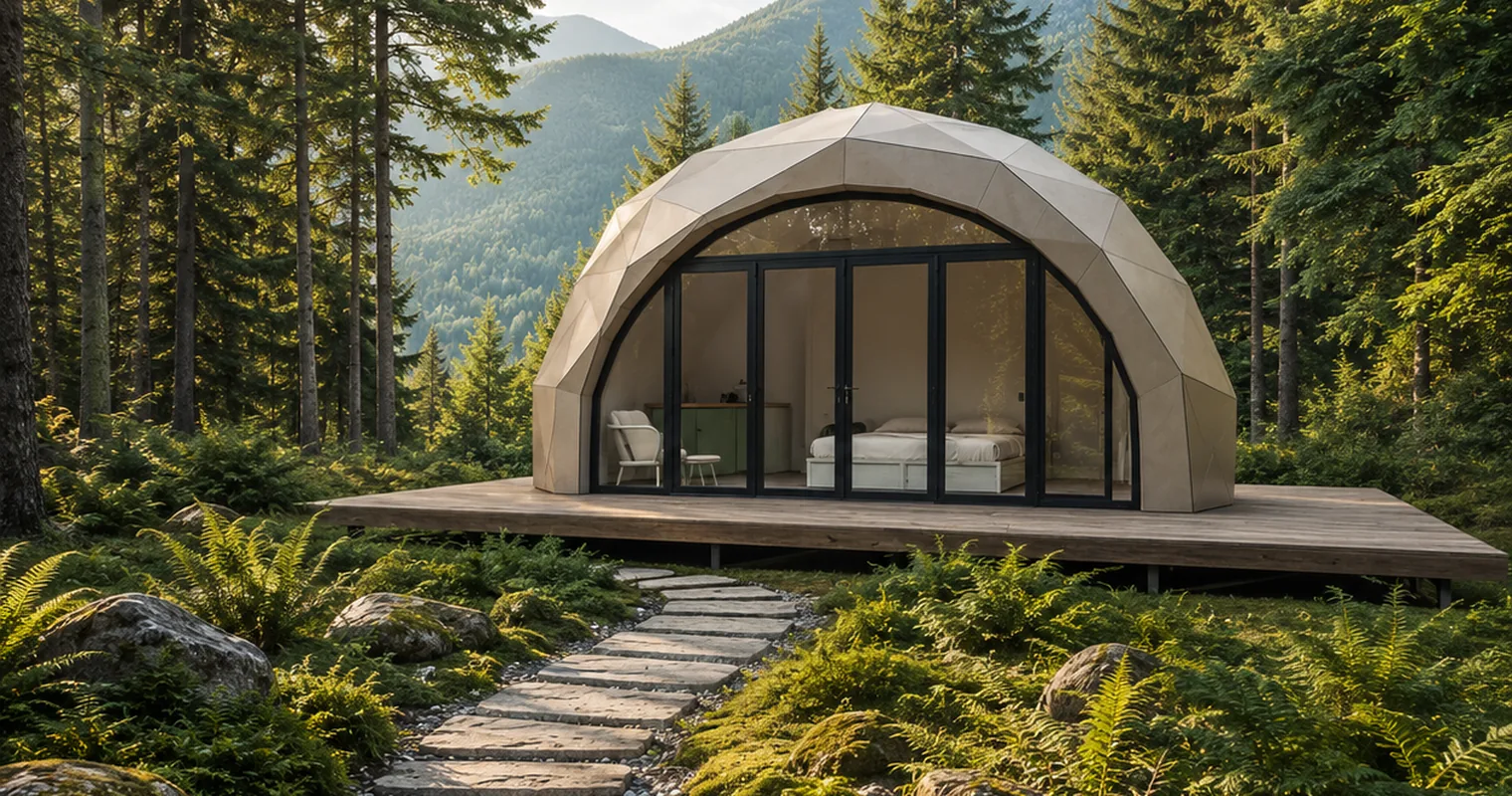
When people picture a low-energy house, they think of thick walls, triple glazing and solar panels. Another factor is easy to miss: the shape of the building itself.
The geometry of a sphere
Among shapes with the same surface area, a sphere encloses the most volume. For a given interior, a dome needs less shell than a box.
A geodesic dome 6.8 m in diameter (35 m² of floor) has about 28% less outer surface than a rectangular house of the same floor area.
What that means for heat loss
Heat leaves through the outer surface. Less surface, with the same insulation, means less loss. In our measurements a KUPOLLA dome uses 30–35% less heating energy than a 35 m² rectangular house with the same insulation.
Wind
A round form has no corners for the wind to catch. The dome is specified for wind up to 200 km/h and does not build snow drifts on eaves.
Air movement
Warm air rises to the apex, where it can leave through a vent.
In short
The efficiency of a dome follows from its geometry. With CLT, triple glazing and 200 mm of mineral wool, KUPOLLA reaches energy class A+.
Read also
Screw piles or a concrete foundation under a dome?
How the two foundations compare for different soils and climates.